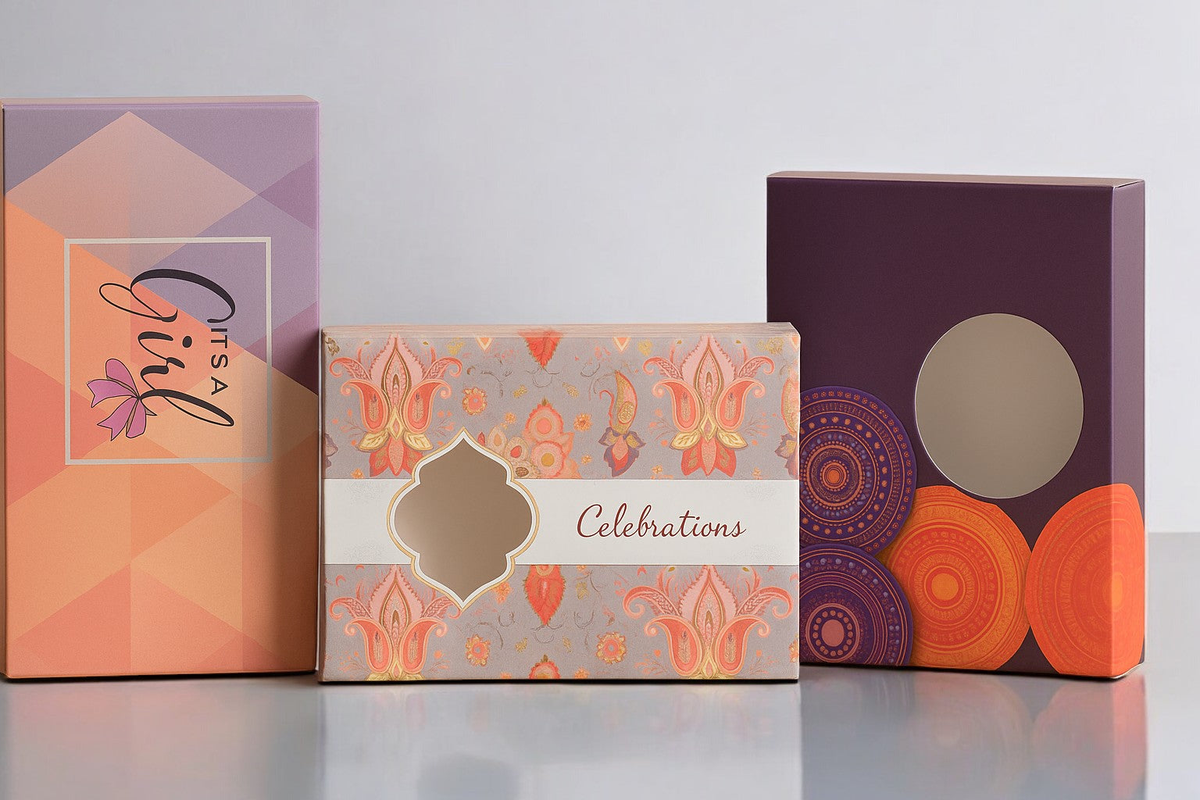


Indian sweets aren’t just desserts - they’re tokens of love, tradition, and festivity. Whether you run a neighbourhood mithai shop in Mumbai or ship gourmet sweets from India to the UK, having the right custom packaging boxes is crucial. It’s the first thing your customer sees, and it speaks volumes about your brand’s quality and care. In fact, studies show over 70% of consumers say a product’s packaging design influences their buying decisions. During peak seasons like Diwali when demand for sweets soars to all-time highs, eye-catching and sturdy packaging can make your brand the go-to choice for buyers. This guide will walk you through everything about sweet packaging – custom sweet boxes explained, how to choose the best mithai boxes (design, materials, bulk buying), leveraging empty Indian sweet boxes for wholesale needs, and creating memorable packaging for festivals and gifting. By the end, you’ll know how to use packaging not just to box your sweets, but to build your business.
Custom Packaging Boxes Explained
Custom packaging boxes refer to tailor-made boxes designed to fit your product and brand, as opposed to generic one-size-fits-all boxes. In the context of sweets and confectionery, this means packaging that’s crafted to protect your sweets, reflect your brand’s personality, and provide a great unboxing experience for the customer. In today’s competitive market, custom boxes have become more than just containers – they’re an essential part of a brand’s identity, storytelling, and customer experience. For example, think of the luxurious feel of a premium chocolate box versus a plain cardboard carton – the custom packaging immediately sets a tone of quality.
Why do custom boxes matter for sweet businesses? First impressions are critical. When a customer receives a box of sweets, the packaging is the very first thing they see and touch. A sturdy, well-designed box signals that you value quality and hygiene, instantly building trust. Conversely, a flimsy or dull box can dampen the excitement, even if your sweets are delicious. Great packaging enhances perceived value, a beautifully printed mithai box with festive motifs can make the sweets inside feel more special (and justify a higher price point) than an unbranded brown box. It’s not just about looks, either: for edible products like sweets, packaging plays a functional role in preserving freshness, preventing damage, and ensuring food safety.
From a branding perspective, custom packaging is a visual ambassador of your business. It uses your logo, colors, and design elements to establish immediate recognition. Imagine customers seeing your stylish box with a logo at a party, that’s free marketing. In the age of Instagram and YouTube, attractive packaging can even lead to unboxing videos or social media shares, turning your customers into brand advocates. A keenly designed sweet box tells your story, communicates your values, and creates an unboxing experience customers remember long after the sweets are gone. This kind of shareable “wow factor” packaging can organically draw new customers who see or hear about it online.
There are also practical benefits: custom dimensions ensure your ladoo and barfi don’t rattle around or get smashed in transit, and custom inserts can keep mixed sweets separated. You can choose food-grade linings or moisture-resistant coatings to handle syrupy sweets (like gulab jamun) without the box getting soggy. And if sustainability is a core value for your business, you can opt for eco-friendly materials and promote that on your packaging – modern consumers appreciate brands that use recyclable or biodegradable packaging, which in turn boosts your brand’s image.
In short, investing in custom packaging boxes is not an extravagance; it’s a strategic move. It differentiates you in a crowded market (where many competitors might still be using generic boxes), it improves the customer’s experience, and it reinforces your brand at every touchpoint. When done right, a custom sweet box can make your sweets even sweeter – both for your customer and for your business’s bottom line.
Sweet Boxes Packaging for Indian Brands
Sweet boxes hold a special place in Indian culture. In India, sweets (or mithai) aren’t just commodities; they carry emotional weight – gifted during Diwali, offered at weddings, exchanged in festivals like Eid and Raksha Bandhan, or simply shared as a gesture of goodwill. For Indian brands, the packaging of these sweet boxes needs to tap into that cultural significance. How your box looks and feels can directly impact how customers perceive the sweets and, by extension, your brand. As one packaging expert put it, in India, sweets are linked to emotions and tradition, so packaging plays a pivotal role in creating a lasting impression during gift-giving occasions.
Consider the scenario: a customer wants to gift sweets to their relatives for Diwali. They have two choices from two brands – one comes in a bland, generic cardboard box, and the other in a vibrant box adorned with lotus motifs and a “Happy Diwali” message, perhaps even a logo that assures quality. It’s obvious which one feels more festive and thoughtful. The best sweet box packaging reflects your brand identity and values while resonating with the occasion. If your brand is all about traditional authenticity, you might use rich maroons or golds, with classic Indian patterns (like paisleys or temple silhouettes). If you position yourself as a modern, premium confectioner, you might opt for elegant minimalism – say an ivory white rigid box with a foil-stamped logo. Either way, the design should tell a story. A beautifully crafted sweet box isn’t just a container; it’s your brand’s ambassador – it ensures your sweets are remembered long after they’ve been enjoyed.
Indian sweet brands also need to consider regional preferences. For instance, a deli in Delhi might use packaging with Hindi script and local art, while a sweet shop in Chennai might incorporate Tamil script or temple iconography. India’s diversity means there’s no one-size-fits-all design; instead, successful brands often customize their sweet boxes for their target demographics or for specific festivals. We see this in practice with many famous sweet chains that release limited-edition box designs every Diwali or have separate packaging for say, motichoor laddoo vs. dry fruit sweets. This level of thoughtfulness not only delights customers but also reinforces brand loyalty customers feel that the brand “gets” the cultural context.
Branding on sweet boxes can significantly boost recall and trust. A box printed with your logo and tagline will remind the recipient of your brand every time they nibble a sweet or even later when the box is reused (many people repurpose good-looking sweet boxes to store trinkets, etc.). Consistent branding (using the same colors, fonts, and style across all your boxes) makes your products recognizable. This is crucial when you’re trying to stand out among dozens of sweet shops. When your packaging has a distinct identity, customers can spot it in a crowded market or remember it when they need sweets for the next occasion. For example, Haldiram’s or Bikanervala (famous Indian sweet brands) have unmistakable packaging – a customer walking into a store can identify their boxes from afar. That’s the kind of brand recognition to aspire to.
Let’s not forget international buyers and diaspora communities. Indian sweet boxes are no longer confined to India; they’re in demand globally among Indian communities and even foreigners who have developed a taste for mithai. These buyers often search for authentic Indian sweet packaging to use in their own events abroad. In fact, mithai boxes are now commonly used in diaspora communities across North America, the UK, the Middle East and beyond. If you’re an Indian brand shipping overseas or catering to NRIs, your packaging needs to hold up to international standards. This means using strong materials that can survive longer transit, perhaps providing insulation if the sweets are temperature-sensitive, and having designs that balance Indian aesthetics with universal appeal. Often, expatriate customers feel a sense of nostalgia and pride seeing traditional Indian designs on a high-quality box – it’s a little piece of home. By delivering that authenticity with professionalism (no crushed boxes or leaked syrup on arrival!), you earn their trust and repeat business.
Finally, consider perception and positioning. In the Indian market, as elsewhere, packaging can subtly signal who the product is for. Are your sweets a luxury gifting option for corporates and weddings? Then a rigid box with a satin lining might be appropriate. Are you targeting the everyday consumer for casual gifting? Then maybe a cost-effective yet pretty cardboard box with colorful printing will do. Premium packaging might cost a bit more, but it also allows you to charge more. Customers will pay a premium for what looks premium – especially when buying gifts. It’s about aligning your packaging with your brand’s promise. As one design agency noted, the sweet box design should convey whether your brand is luxury, traditional, handcrafted, or modern, so that it speaks to the right audience.
Bottom line: For Indian brands, sweet box packaging is a critical marketing and branding tool. It must resonate with cultural expectations, delight customers during festivals and celebrations, and consistently broadcast your brand’s values. If your current sweet boxes aren’t telling your brand story or exciting your customers, it’s time to rethink and invest in packaging that does. In a market where everyone’s offering similar gulab jamuns and barfis, a standout sweet box can attract customers and make your brand the one they remember and return to.
Mithai Boxes: Design, Material & Bulk Buying Guide
When it comes to mithai boxes – the specific packaging for Indian sweets – there’s a lot more to consider than just looks. This section serves as a design and bulk-buying guide, especially useful if you’re a business planning a large order of custom boxes. We’ll break down the types of mithai boxes available, key design/material considerations (like food safety and durability), and tips for ordering in bulk efficiently.
Types of Mithai Boxes
Not all mithai boxes are created equal. Depending on your brand’s needs and the kind of sweets you sell, you might opt for one type over another. Here are some common types of mithai boxes and their characteristics:
-
Rigid Paperboard Boxes: Sturdy, high-end boxes made of thick paperboard. Often used for premium gifting (weddings, upscale brands). Pros: Very durable, excellent print quality, gives a luxury feel. Cons: Higher cost, and if they have plastic laminations or metallic foils, they may be less eco-friendly.
-
Kraft Paper Boxes: Boxes made from unbleached brown kraft paper or cardboard. These have a natural, rustic look. Pros: Eco-friendly (biodegradable, recyclable) – great for brands emphasizing sustainability. Also cost-effective. Cons: Plain appearance unless printed on; and pure kraft paper can absorb oil from sweets unless there’s an inner lining.
-
Window Boxes: Boxes with a transparent window (often PVC or eco-friendly PLA plastic) on top so the sweets are visible. Pros: Excellent for display – customers can see the ladoo or barfi inside, which can entice purchase. Cons: The plastic window isn’t always recyclable (PVC especially), and it slightly reduces the structural integrity of the lid. Newer window boxes use biodegradable film to address eco concerns.
-
Magnetic Closure / Drawer-Style Boxes: These are specialty luxury boxes – either a top lid with magnetic snaps, or a slide-out drawer style. Often seen in high-end gift hampers. Pros: Extremely premium appearance and often reusable (people might keep them for jewelry or storage). Cons: Very expensive per unit, heavier (affecting shipping), usually only used for high budget projects.
-
Foldable Flat-Pack Boxes: These come flat (to save space in shipping/storage) and you fold them into shape when needed. Pros: Cost-effective in bulk, saves storage space, and shipping of empty boxes is cheaper. You can still customize them with prints. Cons: They may not be as sturdy as rigid pre-assembled boxes, and assembling hundreds of boxes can be labor-intensive for your staff.
Understanding these types helps you pick what aligns with your brand and budget. For instance, a home-based sweet startup might start with foldable kraft boxes (cheap and green), whereas an established brand launching a Diwali gift collection might splurge on magnetic rigid boxes for that wow factor.
Key Design & Material Considerations
When designing your custom mithai boxes or evaluating suppliers, pay attention to the following factors – they determine not just how the box looks, but how well it performs (in protecting sweets, maintaining food safety, and satisfying customers):
-
Material Thickness & Strength: A flimsy box is a disaster for sweets (imagine the base sagging under the weight of a 1kg motichoor laddoo batch!). Ensure the cardboard or paperboard is robust. We recommend around 300–400 GSM thickness for good rigidity. GSM (grams per square meter) is a common measure of paper density – higher means stronger. If you’re talking to a supplier, ask about the material spec. For heavy assortments or export shipments, err on the side of thicker material or corrugated boards.
-
Food-Grade & Safety: Mithai boxes must be food-safe since they directly contact edible items. This means using inks, adhesives and coatings that are certified non-toxic. If you’re getting custom printing, confirm that the printer uses food-safe inks (e.g. soy-based or vegetable inks instead of lead-based dyes). Also, any glue used should be food grade. Don’t hesitate to ask suppliers for compliance – reputable ones can provide FDA-approved or EU food-grade certificates for their packaging. After all, the last thing you want is sweets smelling of solvent or customers worrying about contamination.
-
Closure Mechanism: How the box closes affects both security and user experience. Common closures include tuck-in flaps (the basic top that tucks into the front), two-piece boxes (separate lid and base), magnetic lids, or even ribbon ties for decorative boxes. For bulk orders and shipping, secure closures are a must – you don’t want the box popping open during transit. Tuck flaps with a locking tab, or boxes that can be sealed with a sticker, are good for transport. Magnetic closures add a premium feel and are very secure (but add cost). Ribbon ties are charming for gifts but not practical for stacking or shipping. Choose what fits your use-case: e.g., if it’s for retail display, a window box with a simple tuck flap may suffice; if it’s for high-end gifting, a two-piece rigid box with a snug lid might be better.
-
Printing & Branding: One of the biggest advantages of going custom is that you can print branding and beautiful designs on your boxes. Decide early if you want full-color graphics, minimalist logo, or just a solid color – this will influence cost (full-color or special finishes usually cost more per unit). Modern printers can do vibrant digital or offset printing on boxes, so unleash your creativity: festive artwork, brand logo, tagline, even QR codes to your website or a message. Ensure the printer can meet any brand color requirements (Pantone matching if you have specific brand colors). Also consider inside printing – some brands print a message or pattern inside the lid for an extra nice touch. It’s those little details that impress customers.
-
Moisture & Grease Resistance: Indian sweets can be oily (think ghee-laden mysore pak) or syrupy (rasgullas dripping with syrup). If your sweets are of the moist variety, you need boxes that can handle a bit of moisture without falling apart or staining through. Many mithai boxes have a wax or food-safe laminate coating inside to prevent grease soak. Others come with butter paper liners. Laminated interiors (poly-coated) do a great job protecting the box, but note they might reduce recyclability (a fully plastic-coated cardboard is harder to recycle). An alternative is to include a food-grade paper liner in each box (less convenient for customer though). Evaluate what’s needed based on your product: dry sweets like soan papdi or chocolates might not need any lining; wet ones like gulab jamun definitely do. Also, if your sweets are very hot when packed (some halwais pack them warm), be sure the material can handle it without warping or releasing fumes.
By minding these factors, you’ll choose a mithai box that not only looks great but functions beautifully keeping sweets fresh, intact, and safe.
Remember, investing in good mithai boxes is investing in your product’s presentation and safety. It enhances customer satisfaction and can even reduce losses (less breakage, returns, or complaints about messy packaging). By following this guide to design and bulk-buying, you can make informed decisions that honor tradition while meeting modern business needs. The result will be packaging that delights customers and does justice to the sweet treats you so lovingly create.
(Pro Tip: Always keep an eye on feedback once you start using new packaging. If multiple customers mention something like “loved the sweets, but the box was a bit hard to open” or “the box design was beautiful!”, take note. Continuous improvement in packaging can be a secret weapon for outperforming competitors in the long run.)
Empty Indian Sweet Boxes for Retail & Wholesale
If you’ve been searching for empty Indian sweet boxes, you likely fall into one of two categories: (1) a sweet shop or business looking to purchase packaging in bulk for your products, or (2) an individual/event organizer wanting empty boxes to pack homemade sweets or party favors. This section addresses both by discussing what “empty sweet boxes” usually means in the market, where to find them wholesale, and how they can be used effectively.
“Empty Indian sweet boxes” are essentially pre-made boxes (often with generic designs) sold in bulk without any sweets inside. They’re ready-to-assemble or ready-to-pack packaging. Many suppliers offer these as stock items, especially in standard sizes like 250g, 500g, 1kg capacities since these correspond to common sale quantities at Indian sweet shops. For instance, a “500g mithai box” is a typical size used across India for half-kilo sweet assortments. These standard empty boxes are convenient for retailers – you simply buy a batch of boxes and use them to pack whatever sweets the customer orders. They usually come collapsed flat and can be popped open when needed.
From a wholesale perspective, buying empty sweet boxes is very cost-effective. They are often sold in bulk packs (25, 50, 100 boxes in a pack). For example, in the UK you can purchase packs of 25 empty 500g mithai boxes for local use, and in India it’s common to buy by the carton (e.g., 100 or 200 boxes per carton). The pricing is attractive due to economies of scale. To illustrate, on Alibaba there are listings for simple empty sweet boxes as low as ~$0.10 – $0.20 per box when you order 100+ pieces. This means even small businesses or home entrepreneurs can get decent packaging without breaking the bank. At these prices, the boxes might be plain or have a generic festive print, but not personalized with your brand. Many local packaging wholesalers in India (in markets like Delhi’s Sadar Bazaar or Mumbai’s Crawford Market) also sell empty mithai boxes in bulk at very low rates – essentially the commodity version of packaging.
What do these boxes look like? Stock empty sweet boxes often have traditional motifs or festive colors (reds, yellows, gold) because they’re meant to be versatile for any occasion. Some are very minimal – just solid color boxes – allowing the sweet shop to perhaps stamp their logo or stick a label. Others come pre-decorated with generic messages like “With Best Compliments” or images of Indian sweets. The idea is to be broad appeal. Even on Etsy, you’ll find creative takes – for instance, handmade or bespoke empty Indian sweet boxes meant as wedding favor packaging. Those might be more decorative (think bride-groom caricatures on a sweet box for a wedding favor, etc.), and they cater to individuals planning events who want something unique but don’t need thousands of them.
For retail sweet shops, empty boxes are an inventory item you must manage. You’ll typically stock different sizes: maybe a 250g for small orders, 500g as the most common, 1kg for large orders, and possibly 2kg for big gift assortments. It’s important to get good quality even in these stock boxes – nothing fancy, but they should hold the weight and grease of sweets. Often, local sweet shops buy boxes from a vendor who specializes in food packaging. If you’re running such an operation, it pays to compare a bit – some boxes use slightly thinner card to cut cost and you don’t want boxes collapsing under a heap of laddoos! Also, consider the customer experience: boxes that are too thin can feel cheap and might reflect poorly on your brand, even if you haven’t invested in fully custom printed ones.
One advantage of using stock empty boxes is flexibility. You can use them for walk-in customers daily, for large bulk corporate orders (with maybe a custom sticker of your brand on the lid), or even resell them if you have excess (some smaller shops source from bigger shops in a pinch). And if you do seasonal special packaging (say, special Diwali themed boxes), you can still keep generic ones in stock for off-season use. Unprinted or simply designed empty boxes won’t go out of style, so unused inventory isn’t a big risk.
For individuals, buying empty sweet boxes is popular around festivals. Imagine you make homemade sweets and want to send them to friends and family for Diwali – you’ll need boxes to put them in. You can actually find these boxes in retail online nowadays. A quick search on Amazon or eBay yields results like “Indian sweet boxes – pack of 10” and so on. They often come flat and you fold them yourself. Prices are slightly higher at retail, but still reasonable. We even see culturally specific designs abroad: there are Eid and Ramadan themed empty mithai boxes available in markets like the UK, showing the demand in various communities. So, if you’re targeting international buyers or diaspora, consider that they too might be looking for just the boxes to fill with local sweets or homemade treats. As a business, selling empty boxes could even be a side offering if you produce them at scale – some packaging companies do sell to end consumers in small lots.
Tips when ordering empty boxes wholesale:
-
Check the Size (Dimension vs Weight): If a supplier says “1/2 kg sweet box”, confirm the actual dimensions and how many pieces of your typical sweet it fits. Weight can be a misleading measure because 500g of soan papdi occupies more volume than 500g of dense kaju katli.
-
Inquire About Food Grade Quality: Even if the boxes are stock designs, ask if they’re food grade (most are, but ensure no weird dyes or contaminants). They should ideally be inked on the outside only, or with a safe lining inside.
-
Bulk Packaging: These empty boxes themselves will be delivered in bulk cartons. The boxes often come flat-packed. Make sure you or your staff know how to fold them (it’s usually intuitive: fold along creases, tuck tabs). Practice a few so you can estimate how much time it takes to assemble, especially if you have to pack hundreds during Diwali rush.
-
Storage: Keep them flat until use to save space. Store in a dry place as mentioned earlier. Also, keep away from strong odors – cardboard can sometimes absorb smells (you wouldn’t want your sweet boxes smelling like spices or cleaning chemicals).
-
Customization on Stock Boxes: If you can’t invest in fully custom printed boxes yet, a good hack is to use stickers or stamps. Many businesses buy a simple gold or white box and then add a branded sticker or a festive sticker on top. It’s a cheap way to personalize. Another idea: ribbon. For gift orders, tying a ribbon around a plain box transforms the presentation.
In summary, empty Indian sweet boxes are an accessible solution for packaging, especially for those on a budget or needing standard sizes quickly. They are like a blank canvas – you can use them as-is, dress them up, or even personalize in small ways. From local halwai shops to global e-commerce, these boxes make it possible to deliver sweets to customers efficiently. If your goal is to get packaging that’s good enough to safely carry your sweets and look decent, going with stock empty boxes is a smart route. And as your business scales or during special campaigns, you can gradually shift to fully custom packaging. Many brands use a mix: generic boxes for routine sales and custom high-end boxes for special occasions or VIP clients. Do what fits your stage and strategy.
Finally, if you’re an event organizer or just someone sending sweets to loved ones: don’t underestimate the charm of these boxes. Packing your handmade barfis in a neat Indian sweet box adds an authentic touch that recipients will appreciate – it shows thoughtfulness and elevates the homemade goodies to the level of a professionally packaged gift.
Custom Packaging for Festivals & Gifting
One of the most exciting aspects of custom packaging is tailoring it for festivals and special occasions. In India (and among Indian communities worldwide), festivals like Diwali and Eid, or life events like weddings and corporate celebrations, drive a huge demand for sweets – and not just the sweets, but also fancy packaging that accompanies them. Let’s delve into how custom packaging plays a role in festive and gifting scenarios, and how you as a business can capitalize on these opportunities.
Diwali & Festive Season Packaging
Diwali is to sweets what Christmas is to cookies – an inseparable duo. It’s the peak time when individuals and companies alike order sweets in bulk to gift. A well-designed Diwali sweet box can become a keepsake. Customers often look for something extra special during this season. Packaging for Diwali typically features vibrant colors like gold, red, orange – colors that evoke a festive atmosphere – and motifs such as diyas (lamps), rangoli patterns, or Lord Ganesha illustrations. Using such thematic elements instantly signals “this is a Diwali gift!” and heightens the recipient’s excitement. Many big sweet brands release limited edition Diwali packaging each year, knowing collectors and corporates will scramble for the most beautiful ones.
For example, you might produce a luxury rigid box for Diwali that has gold foil prints of fireworks or a “Happy Diwali” message. Add a satin ribbon or a greeting card, and it’s no longer just a box of sweets – it’s a complete gift package. If you can incorporate a personal touch – even something as simple as a space to write the recipient’s name or a generic greeting inside the lid – it goes a long way. Personalized packaging (like including the recipient’s name or a custom message) is a trend in festival gifting, and while doing it at scale is challenging, even small gestures can be done: e.g., a line that says “Wishing you prosperity – From ______ (Your Company Name)” on corporate gift boxes.
Corporate Diwali gifts often involve sweets, and companies usually compete subtly via the packaging of the gifts they send out. If you’re targeting corporate orders, emphasize how your custom boxes can include company logos alongside festive designs. For instance, a box could have a beautiful Diwali theme but also the corporate client’s logo printed discreetly – so the recipient associates that goodwill with the company. The packaging here has to reflect both festivity and professionalism. High-quality materials (rigid boxes, magnetic closure, etc.) are common for corporate orders because it’s about impressing clients or employees.
Another key aspect nowadays is eco-friendly festive packaging. Especially for Diwali, where there’s growing awareness about not creating excess waste (think of the piles of used sweet boxes after the festival). Brands that introduce biodegradable or reusable Diwali sweet boxes can really stand out. For example, using sturdy cardboard that can be reused, or simple designs without plastic laminates so they can be recycled easily. Many consumers appreciate sustainable choices; a stat from festive packaging trends notes that customers actively seek eco-friendly options for festival gifts. You could even print a small note on the box: “This box is eco-friendly – please recycle or reuse!” to let recipients know.
Weddings, Events & Gifting
In Indian weddings, it’s customary to give guests a box of sweets (often something like mithai or chocolates) as a return gift or include sweets with the wedding invitation. This is a huge market for custom sweet boxes. Wedding sweet boxes tend to be elaborate: they might match the wedding theme colors, include the bride and groom’s names or initials, and have luxurious touches (foiling, embossing, etc.). If you’re a packaging provider or a sweet brand catering to weddings, you’ll want to offer personalization – e.g., custom prints for each wedding. Fortunately, since wedding orders are usually large (hundreds of guests), doing a limited print run with the couple’s name is feasible and often expected. We’ve seen trends like pyramid-shaped sweet boxes or gabled boxes with handles for easy carrying, used in weddings to make the packaging itself a conversation piece. The idea is to make it memorable, as weddings are once-in-a-lifetime (hopefully!) events.
For wedding packaging, focus on elegance and sturdiness (people might keep these boxes as mementos). Common materials are rigid board or high-quality art paper with inserts (to hold multiple types of sweets without mixing). Culturally, certain motifs like peacocks, elephants, or intricate floral patterns are popular in Indian wedding aesthetics. Also, consider offering coordinated designs – some couples like their invitation card design to match the sweet box design for a cohesive look.
Now, corporate gifting (outside of Diwali) – this includes occasions like company anniversaries, product launch events, or client thank-you gifts. Here, the packaging should align with the company’s brand image. Often, less is more: a sleek box in the company’s brand color with a subtle gloss logo could be very effective. What’s inside could be traditional sweets or modern treats, but the box should exude professionalism and quality. Corporate clients also appreciate if the packaging is functional and reusable (like a nice tin or a wooden box) because it adds to the perceived value. While that goes slightly beyond paper boxes, some sweet brands do offer sweets in decorative tins or jars for corporate gifts. If sticking to boxes, a drawer-style box or a magnetic lid box that feels like opening a present works well. Interactive or novel packaging (like a box that opens to reveal a message or a pop-up logo) can really wow recipient, though it requires more design ingenuity.
Let’s not forget other festivals: Eid, Christmas (for Christian communities in India or for global outreach), New Year, Raksha Bandhan, Ganesh Chaturthi, etc. Each of these has its own vibe. For Eid, for example, green and gold with star-and-crescent motifs, or a modern geometric Islamic pattern, would resonate. Some businesses do a lot of sweets for Christmas and New Year (plum cakes, cookies along with Indian sweets), so having a “Season’s Greetings” generic holiday box might help capture that market too. The principle remains – align with the occasion. Customers are often specifically searching for “Diwali sweet box” or “Eid gift box for sweets,” so having content (and products) tailored to those terms helps SEO and sales.
Maximizing the impact of festive packaging: Use it as a marketing opportunity. Social media is flooded with images of gifts during festive times. If your sweet box is gorgeous, people will post it or at least remember it. We’ve seen that a visually stunning package can create a lasting impression and even influence buying decisions for gifts – because when someone is gifting, they want the presentation to reflect well on them. By providing that elevated packaging, you’re essentially helping your customers gift with pride, and they’ll prefer you over competitors next time. Also, don’t shy from adding a tiny branding on these boxes – it’s a delicate balance (you don’t want to ruin the aesthetics by plastering your logo prominently on a wedding gift box, for example). But a subtle imprint or a tagline on the underside or in an unobtrusive spot ensures people know where it came from, which can bring referral business.
Lastly, consider combos or packaging add-ons: For example, a festive packaging kit – a sweet box plus a matching paper bag, or a box plus a greeting card. Mint Print Packaging could upsell such additions. Customers who are sending gifts often need carry bags or notes; if you supply a one-stop solution with consistent design, that’s extra value (and revenue) for you.
In conclusion, custom packaging for festivals and gifting is where creativity meets strategy. It’s about tapping into the emotional pulse of the occasion. When done right, the packaging enhances the joy of giving and receiving sweets. A Diwali mithai box that lights up faces, or a wedding sweet box that guests admire, directly translates to customer satisfaction and positive brand recall. So, align your packaging designs with the calendars of celebrations, and you’ll find that each festive season becomes a peak sales season for you not just in volume of sweets, but in the buzz your beautiful boxes create.
(And yes, if you’re wondering, people do judge a gift by its cover! So let’s make sure your sweet gifts always come dressed to impress.)
Frequently Asked Questions (FAQ)
Q: What are custom sweet boxes?
A: Custom sweet boxes are personalized packaging boxes designed specifically for sweets or desserts. Unlike generic boxes, custom sweet boxes are made to fit a brand’s needs – you can choose the size, shape, material, and add your branding or unique designs. For example, a bakery or mithai shop might get custom boxes printed with their logo and artwork to pack their sweets. The goal is to protect the sweets and make your product memorable. These boxes often have features like special inserts (to hold sweets in place), festive designs, or premium finishes, depending on the brand’s requirements.
Q: Can I get sweet boxes made for specific occasions like Diwali or weddings?
A: Absolutely. In fact, customizing sweet boxes for festivals and events is very popular. Many businesses create limited-edition designs for occasions such as Diwali, Eid, Christmas, or weddings. For example, you could have boxes that say “Happy Diwali” with diya graphics for the festive season, or elegant boxes with a bride and groom’s name for wedding favors. These occasion-specific boxes add a special touch and make the gift more meaningful. If you’re a business, offering themed packaging can attract customers looking for that celebratory feel. And if you’re ordering for an event (like a wedding or corporate function), most packaging suppliers can incorporate your desired colors, themes, and even personal messages or names into the box design.
Q: What materials are typically used for sweet boxes, and are they food-safe?
A: Sweet boxes are generally made from food-grade cardboard or paperboard. Common materials include SBS (solid bleached sulfate) board which has a smooth white finish ideal for printing, or kraft cardboard for a rustic look. These are safe for direct contact with food. Many sweet boxes also have an inner laminated layer or use inks that are food-safe, meaning they won’t contaminate the sweets. When ordering custom boxes, always ensure the supplier uses food-grade inks and glues – reputable suppliers will comply with FDA or equivalent food safety standards. In terms of thickness, as mentioned earlier, 300-400 GSM board is common for sturdiness. Some boxes might include a thin plastic window (PVC or eco-friendly PLA) to display the sweets – the portion touching food usually is just the cardboard around it. If you’re concerned about eco-friendliness, you can ask for biodegradable or recyclable materials. Kraft paper boxes, for instance, are eco-friendly and food-safe (often used with a butter paper liner). In summary, sweet boxes are made of safe paper materials by default; just avoid any that seem to have strange chemical smells or residues, and you should be fine.
Q: Are sweet boxes eco-friendly or recyclable?
A: They can be. Many sweet boxes are fully recyclable, especially if they are just paperboard without a plastic coating. For example, a basic cardboard mithai box can be tossed in the recycling bin once the sweets are gone. However, if the box has a glossy laminate or a plastic window, its recyclability might be reduced (the plastic window should be removed before recycling the cardboard part). The good news is that there’s a growing trend towards eco-friendly packaging in the sweets industry. You can get sweet boxes made from recycled cardboard or even innovative materials like bamboo paper. Some are biodegradable or compostable. If sustainability is important to you, opt for kraft boxes or boxes labeled as eco-friendly. Also, reusability is a factor: many rigid sweet boxes or tins are actually kept and reused by customers (e.g., to store odds and ends), which is great since it avoids waste. To sum up, sweet boxes are as eco-friendly as you make them – plenty of options exist for recyclable and biodegradable designs. Just communicate with your supplier about it. Mint Print Packaging, for instance, can guide you to eco-conscious choices like soy-ink printing and recyclable materials for your custom boxes.
Q: What sizes do mithai boxes come in, and how do I choose the right size?
A: Mithai boxes come in various sizes, often described by the weight of sweets they can hold or by dimensions. Common sizes (in India) are the 250 gram box, 500 gram (half kilo) box, 1 kilo box, etc. These roughly correspond to: a 250g box might be around 4x4 inches base, a 500g box around 6x6 inches or 5x7 inches, and a 1kg box maybe 8x6 inches or larger – but these dimensions aren’t fixed, different manufacturers use slightly different templates. To choose the right size, consider what sweets you’ll pack and how many pieces or weight. If you sell pieces (like barfis or pedas), think in terms of piece count: e.g., “I want a box that fits 12 pieces without them touching or getting smushed.” If you sell by weight, factor in a little extra room so the sweets aren’t overpacked. A rule of thumb: measure the largest sweet (or the typical arrangement of sweets) and ensure the internal dimensions of the box give a few millimeters of wiggle room. For assorted sweets, you might also use inserts (like section dividers) which can affect box size. Another tip – it’s usually better to have a slightly larger box than one that’s too tight. You can always add a bit of food-safe tissue to fill gaps if a box is not full. But if it’s too small, you risk squashing the sweets or not closing the lid properly. If you’re unsure, request sample boxes in a couple of sizes and do a test run by placing your sweets as you would for a customer.
Q: How can I order custom sweet boxes in bulk? Is there a minimum order quantity (MOQ)?
A: Ordering custom sweet boxes in bulk is straightforward, but you’ll typically encounter an MOQ (Minimum Order Quantity) from suppliers. Most printers or packaging companies require a certain minimum – often around 500 units or 1000 units – for a custom print run, because of the setup costs involved in printing and die-cutting boxes. The process to order usually goes like this:
-
Design – You provide your logo, design ideas, or work with the supplier’s design team to finalize how the box will look (size, artwork, etc.).
-
Quote & MOQ – The supplier gives you a price quote, often tiered by quantity. For example, 500 boxes might be X per box, 1000 boxes a bit cheaper per box, etc. You’ll need to meet at least the minimum they specify.
-
Sampling – For a large order, you can ask for a pre-production sample (sometimes free, sometimes at a small cost) to approve the materials and print quality.
-
Production – Once you okayed the sample and paid a deposit, they’ll print and manufacture the boxes. This can take anywhere from a week or two to several weeks depending on quantity and complexity.
-
Delivery – The boxes are shipped to you flat-packed (usually). You pay the remainder if any upon delivery.
If you cannot meet the MOQ of a supplier, don’t be discouraged. There are options: some digital printing companies can do shorter runs (even 100 boxes) but at a higher cost per box. Another hack is to use a “stock base, custom top” – for example, use a standard size/template box but print a custom sleeve or sticker to brand it. This way you might use, say, 200 stock boxes and just order 200 custom belly-band wraps for them, avoiding high MOQs. But ideally, if you’re serious about branding, investing in the MOQ and storing the extra boxes (they last a long time if kept dry) is worth it for the cost savings per unit.
Mint Print Packaging (our company) understands that MOQs can be a hurdle for small businesses, so we try to keep it reasonable and can also store your excess packaging if needed, releasing in batches. In essence, yes, there usually is an MOQ, but it’s there to ensure cost-effectiveness. Plan your inventory (consider upcoming festivals, etc., so you order enough in one go) and you’ll find bulk ordering of custom boxes to be both economical and convenient.
Q: How much do custom sweet boxes cost, and are they much more expensive than stock boxes?
A: The cost of custom sweet boxes can vary widely based on size, material, and design, but let’s give some ballpark figures. A plain stock 500g sweet box (generic design, bulk purchase) might cost, for example, ₹10-₹20 in India (or ~$0.20 each as mentioned earlier for large orders). A fully custom-printed box of the same size might cost somewhat more – perhaps ₹25-₹40 ($0.30-$0.60) each in a decent quantity order. If you add special features like lamination, embossing, foil stamping, etc., the price goes up accordingly. Premium rigid boxes or large gift boxes could be ₹100+ ($2 or more) each. So yes, custom boxes are typically more expensive per unit than stock boxes, but not by an order of magnitude – often just a moderate increase which you can factor into your product pricing.
It’s important to consider the value addition: a custom box can allow you to market your brand (logo exposure), possibly attract more customers, and even justify a slightly higher selling price for your sweets due to the improved presentation. Many customers are willing to pay a little extra for a gift-ready package. Also, when ordered in bulk, the cost per custom box drops. So if a stock box is ₹15 and a custom comes to ₹25, that ₹10 difference might be well worth the branding benefit.
In contrast, not having custom boxes has an “opportunity cost” – you miss branding opportunities and perhaps perceived value. In short, while custom boxes do cost more, they can be quite affordable at scale and are a smart investment in your brand image. We always advise clients to calculate how much packaging cost is as a percentage of product cost. If a box is, say, 5% of the price of the sweets you’re selling inside it, that’s a reasonable marketing spend. Plus, with the right supplier (hi there!), you can find options that fit various budgets. Customization can be tailored – maybe you go for one-color printing instead of four-color to save cost, or use a slightly thinner board if that’s acceptable – there are ways to optimize the price.
Q: Can sweet boxes be reused or are they single-use only?
A: It depends on the type of box and how it’s handled. Many basic folding sweet boxes (the thin cardboard kind) are intended as single-use, in the sense that they’re inexpensive and often get thrown away or recycled after the sweets are consumed. However, if opened carefully without tearing or staining, there’s nothing stopping one from reusing them to store other items or regift something. That said, they may not be very durable for long-term use (corners might start wearing, etc.). On the other hand, premium sweet boxes and tins are often reused. Those sturdy decorative boxes you get during weddings or Diwali – people repurpose them to store jewelry, spices, dry fruits, or any knick-knacks at home. We’ve seen customers even come back to refill a high-quality box with more sweets! From a business perspective, you might actually encourage reuse by making the box pretty and durable (that way your brand name/logo stays around in the customer’s house longer – free marketing!). If you specifically want your boxes to be reused, consider rigid boxes or magnetic closing boxes which are definitely not one-time throwaways. Also, eco-conscious consumers sometimes prefer reusing to reduce waste, so a well-made box aligns with that ethos. In summary, yes, sweet boxes can be reused especially if they’re of good quality. Single-use is common, but with custom packaging you have the opportunity to design a box that has a life beyond just delivering sweets – turning it into a keepsake or storage box can be a delightful bonus for your customers.
Q: How do I ensure my sweets don’t stick to or spoil the box (especially sticky or syrupy sweets)?
A: This is a great practical question. Indian sweets come in a variety of textures – some are dry and flaky, others oily, and some are swimming in sugar syrup. To prevent sweets from sticking to the box or causing any kind of leakage or spoilage of the packaging, consider these tips:
-
Use Food-Grade Liners: Most sweet shops place a butter paper (parchment paper) or wax paper sheet inside the box as a liner. This creates a barrier between the sweets and the cardboard. It’s particularly useful for syrupy sweets like gulab jamun or jalebi, as it absorbs some syrup and prevents the bottom from getting soggy.
-
Partition & Cupcake Liners: For mixed sweets, using little paper cups (like cupcake liners) for each piece or paper dividers will prevent them from sticking to each other or the box. Dry fruits sweets or chocolate-dipped ones are often placed in small liners within the box.
-
Coated Interiors: As mentioned earlier, some custom boxes come with a wax-coated or PE-coated interior that is semi-glossy. Sweets are less likely to stick to that surface compared to raw cardboard. It also provides a moisture barrier. Make sure any such coating is food-safe.
-
Temperature Matters: Don’t pack hot sweets into boxes and immediately close them. The steam can create condensation, leading to moisture buildup that weakens the box and makes things soggy. Let sweets cool to near room-temp (or just slightly warm) before boxing, especially for things like hot halwa.
-
Avoid Overpacking: Cramming too many sweets can press them against the lid, causing stickiness. Always allow a bit of headroom. If you notice the top of a sweet (like a barfi with silver foil) is touching the lid, use a taller box or reduce the quantity per box.
-
Customer Instructions: If you’re giving out very syrupy sweets in paper boxes, you might include a gentle note like “Please keep this box upright to avoid leakage” – a simple graphic icon on the box can also indicate this. And advise customers that these are short-term containers (most mithai boxes are not meant for long storage in fridge or such – transfer to airtight if keeping long).
By designing thoughtfully and handling properly, you can ensure that even the juiciest rasgulla doesn’t break through or fuse with your box. Good packaging is about function as much as form – and your customers will appreciate sweets that arrive neat and intact, without half of the syrup left in the box instead of the sweets!
Q: Are mithai boxes safe for refrigeration or microwave use?
A: Generally, mithai boxes are not designed for the fridge or microwave. They are meant for short-term presentation and transport. Standard paperboard boxes can handle cool temperatures of a refrigerator for a short period (e.g., a day or two) but the moisture in a fridge could soften the cardboard over time. Also, any print or embellishments might suffer. As for microwaving – it’s not recommended to microwave sweets in their cardboard box. Most mithai boxes have some metal content (for example, many have a thin foil coating or metallic ink, and notably sweets themselves often have that edible silver leaf – chandi varkh – which you definitely shouldn’t microwave!). Microwaving could cause sparks due to those metal elements, and it could leach chemicals from inks/adhesives into the food when heated. If a customer wants to warm a sweet, they should remove it from the box and use a microwave-safe dish.
For refrigeration, if you must store sweets in the box, ensure it’s well sealed (maybe cling-wrap the whole box or put it in a ziplock bag to avoid fridge humidity getting in). However, the best practice is to transfer sweets to an airtight container for longer storage. You can convey this to customers as well if it’s relevant (perhaps in a care instruction note).
In short: no microwaving, and fridge is okay only for short durations and with caution. When designing your boxes, you don’t really have to make them fridge/microwave-proof – focus on room-temperature performance, as that’s the typical use case.